
A project of Food is Medicine Massachusetts

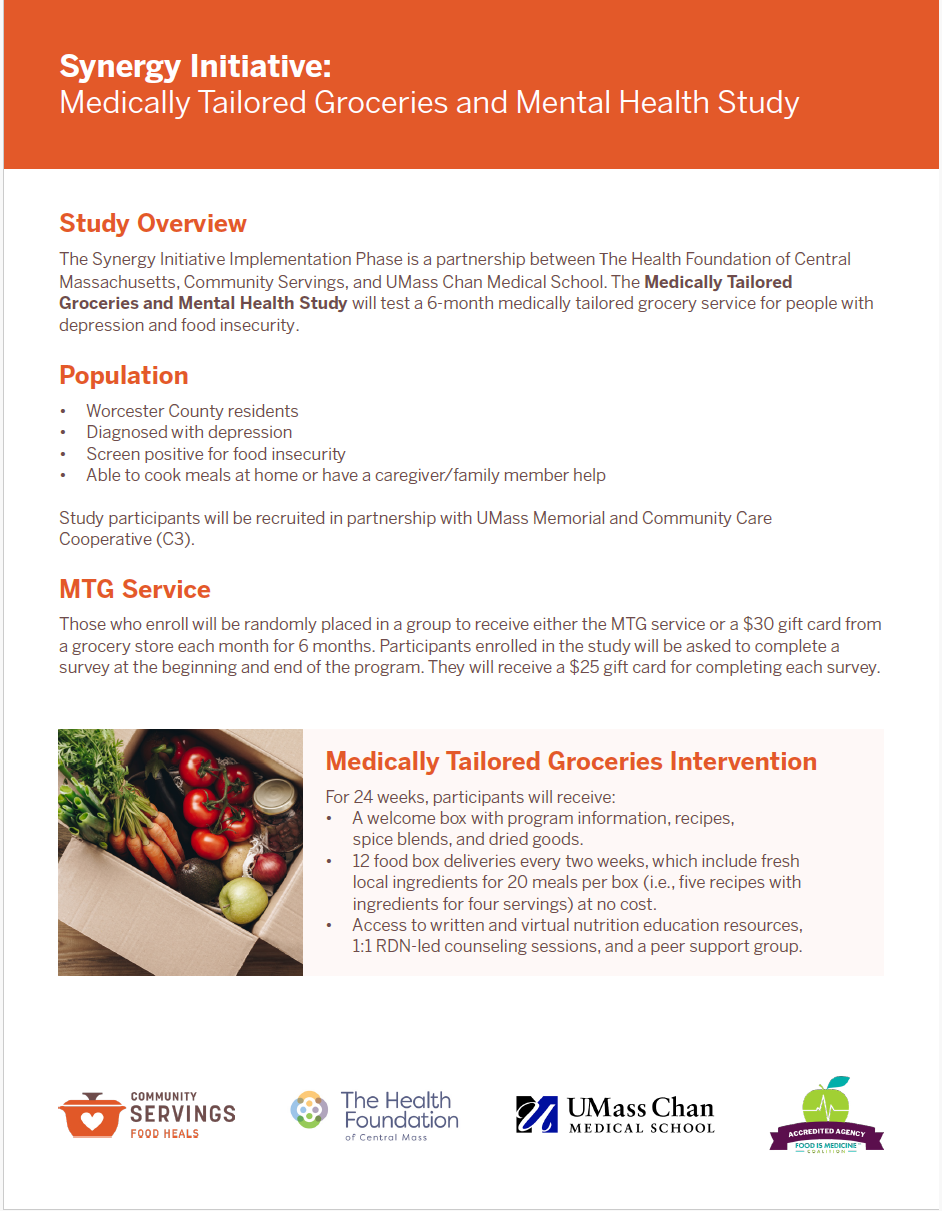
Community Servings, a co-convener of FIMMA, was awarded a $472,000 from the Health Foundation of Central Massachusetts (HFCM) to conduct The “Medically Tailored Grocery Synergy Project: Randomized Control Trial (RCT) for Food-Insecure Patients with Depression”. With a focus on the primary diagnosis of depression, the project proposes to evaluate the causal impact of the MTG intervention on depressive symptoms. Learn more about our previous work on the Synergy Initiative here.
The “Medically Tailored Grocery Synergy Project: Randomized Control Trial for Food-Insecure Patients with Depression” project (MTG: RCT) will test a 6-month medically tailored grocery intervention for individuals with a primary diagnosis of depression who screen positive for food insecurity. This proposal is based on the feedback received from participants during qualitative interviews as well as from partners, and the lack of studies evaluating the impact of MTG on depression. Our goal is to recruit 300 participants during the next 3 years, who will be randomized to either receive the MTG intervention or food subsidies in a form of a gift card.
With a focus on the primary diagnosis of depression, the project proposes to evaluate the causal impact of the MTG intervention on depressive symptoms (primary outcome), with secondary outcomes of anxiety symptoms, food insecurity, dietary quality, and exploratory outcomes on acute healthcare utilization, including emergency department visits and hospitalizations.
Please contact Carmenmari Zaballa at czaballa@servings.org for questions or more information.
Our mission is to actively engage the community to provide scratch-made, medically tailored meals to individuals and their families experiencing critical or chronic illness and nutrition insecurity. We commit, in all our programs and business practices, to prioritize racial and economic justice and health equity.
We envision a world in which everyone has access to the nutritious food they need for health and wellbeing as a fundamental right.

The mission of The Health Foundation of Central Massachusetts is to use our resources to improve the health of those who live or work in the Central Massachusetts region, with particular emphasis on vulnerable populations and unmet needs.

The Center for Health Law and Policy Innovation (CHLPI) advocates for legal, regulatory, and policy reforms in health and food systems, with a focus on the health, public health, and food needs of systemically marginalized individuals. CHLPI’s broad range of initiatives aim to expand access to high-quality health care and nutritious, affordable food; to reduce health- and food-related disparities; to develop community advocacy capacity; and, to promote more equitable, sustainable and effective health care and food systems. As a clinical teaching program of Harvard Law School, CHLPI’s staff mentor students to become skilled, innovative, and thoughtful food and health system practitioners. Click here to learn more about our work.

Our mission is to advance the health and wellness of our diverse communities throughout Massachusetts and across the world by leading and innovating in education, research, health care delivery and public Service.
Synergy Evaluators:
Kurt Hager is an Instructor in the Division of Epidemiology, Department of Population and Quantitative Health Sciences. Dr. Hager’s interests lay at the intersection of structural determinants of health, food insecurity, and government nutrition and health insurance programs. His current research focuses on the effectiveness of nutritional interventions and policies on chronic disease in the U.S, including evaluations of produce prescriptions and medically tailored meals integrated into clinical care.
Matthew Alcusky is an Associate Professor in the Division of Epidemiology, Department of Population and Quantitative Health Sciences. As a pharmacoepidemiologist and health services researcher, he is primarily focused on generating evidence from large observational data sources to inform clinical practice and guide health policy.
The Health Foundation of Central Massachusetts serves the central Massachusetts region, broadly encompassing the cities and towns around Worcester County.
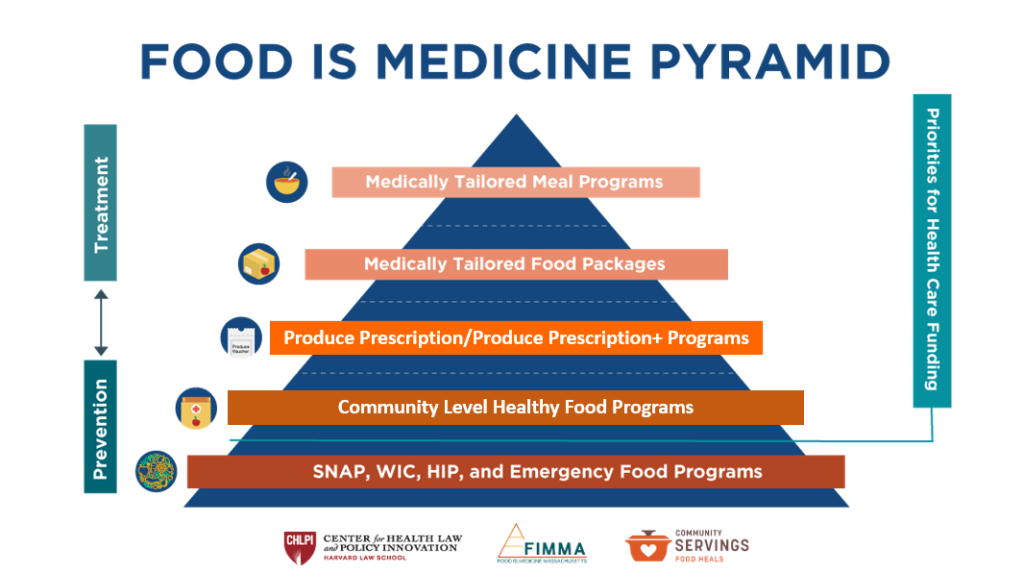
Medically tailored meals (MTM) are meals developed to address the dietary needs of an individual’s medical condition by a Registered Dietitian Nutritionist. Individuals are referred by a healthcare provider or plan.
Medically tailored groceries (MTG) include a selection of minimally prepared grocery items selected by a Registered Dietitian Nutritionist or other qualified nutrition professional as part of a treatment plan for an individual with a defined medical diagnosis. The recipient of medically tailored groceries is typically capable of shopping for and picking up the food and preparing it at home, and is referred by a healthcare provider or plan.
Produce prescriptions/produce prescriptions+ (PRx/PRx+) provide funds for free or discounted nutritious foods. Individuals must receive referrals from healthcare providers or plans after being identified as having or being at risk for diet-related diseases.
Community-level healthy food programs (CLHFP) provide nutritious foods for a population that currently has or is at increased risk for chronic disease associated with food insecurity. These programs are done in partnership or consultation with a healthcare payer, provider or nutrition professional, for screening or referrals, and/or in program design, management, or evaluation.

Senior Director of Policy & Research
jterranova@servings.org

Research Assistant/Project Manager
czaballa@servings.org